
Imagine waking up on a typical Tuesday morning, grabbing your coffee, and heading out the door for your daily commute. But instead of arriving at the office or the job site, a sudden incident changes everything. A severe slip on an icy pavement or the sudden onset of a debilitating illness leaves you hospitalised.
The physical pain and the stress of medical treatment are hard enough to manage. However, as the days of recovery turn into weeks, a new and often heavier anxiety sets in: how will you pay the mortgage? How will you cover the energy bills, keep food on the table, and manage your everyday financial commitments?
For millions of workers across the United Kingdom, this is a very real fear. State support is minimal, and personal savings can drain alarmingly fast when your regular income stops. This is exactly where having the right financial safety net becomes crucial. Understanding personal accident and sickness insurance could easily be the most important financial decision you make this year to protect yourself and your family.
In this comprehensive guide, we will break down exactly how this cover works, why standard policies might leave you exposed, and how to tailor a plan to suit your exact lifestyle and income needs.
What is personal accident and sickness insurance?
At its core, this type of insurance is a protective financial shield. It is designed to replace a portion of your income or provide a lump sum if you are unable to work due to an unexpected injury or an unforeseen medical condition.
Unlike standard life insurance, which pays out to your beneficiaries after you pass away, this policy pays out to you while you are still alive. It ensures that you do not face financial ruin while you are focusing on your physical recovery.
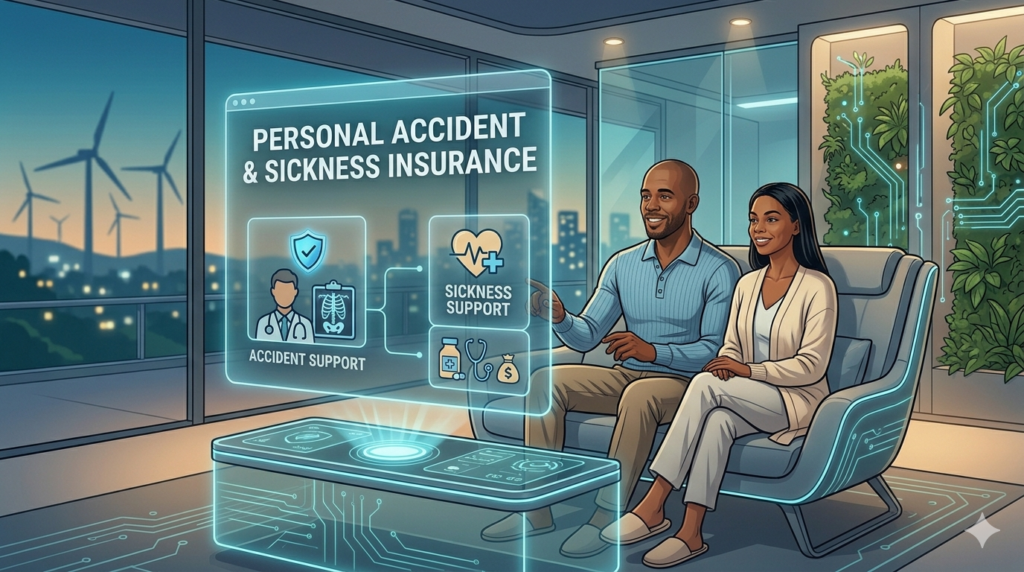
This type of policy is typically split into two distinct parts:
- The Accident Element: This covers you if you suffer a bodily injury resulting from a sudden, unforeseen, and external event. Think of car crashes, falls from scaffolding, or severe sports injuries.
- The Sickness Element: This covers you if you develop an illness or disease that renders you medically unfit to carry out your normal occupation. This could range from a severe viral infection to a more complex, long-term condition.
If you are unfamiliar with the foundational basics of accident cover, we highly recommend reading our detailed breakdown first.
While we have already discussed what is personal accident cover in detail.
Why standard personal accident cover isn’t enough for long-term illness
Many people in the UK assume that a basic personal accident policy is enough to keep them secure. They buy a cheap policy, file the paperwork away, and assume they are fully protected. Unfortunately, this is a dangerous misconception.
Standard personal accident insurance does exactly what it says on the tin: it only covers accidents. If you break your leg playing rugby or fracture your wrist falling off a ladder, an accident-only policy will step in to help.
However, accident-only policies entirely exclude illness and disease. Statistically, you are far more likely to be signed off work for a prolonged period due to an illness than an accidental injury.
Consider the following scenarios where standard accident cover would offer absolutely no help:
- Developing a severe heart condition that requires surgery and months of rest.
- Being diagnosed with a serious neurological illness.
- Suffering from a severe gastrointestinal disease that leaves you bedridden.
- Contracting a severe viral infection that results in post-viral fatigue.
In all these cases, a standard accident policy pays out nothing. By opting for a combined policy that includes sickness cover, you close this massive gap in your financial defence. You ensure that whether your inability to work is caused by a physical trauma or a biological illness, your bills are still paid.
Benefits for self-employed individuals in the UK
The UK economy relies heavily on its self-employed workforce. From freelance graphic designers and IT consultants to independent tradespeople like plumbers, electricians, and builders, being your own boss comes with great freedom. However, it also comes with significant financial vulnerability.
If you are employed by a traditional company, you usually have access to an HR department, sick leave policies, and potentially even corporate income protection schemes. If you are self-employed, you are entirely on your own.
The limits of Statutory Sick Pay (SSP)
When an employed person falls ill, they are usually entitled to Statutory Sick Pay (SSP). Even then, SSP is famously low, offering just £116.75 per week (for the 2024/2025 tax year). It is incredibly difficult to live on this amount, especially with the rising cost of living, high mortgage rates, and standard utility bills.
For the self-employed, the situation is even more precarious. Sole traders are not entitled to SSP at all. If you cannot work, your income instantly drops to zero. You may have to navigate the complex and often lengthy process of applying for Universal Credit or Employment and Support Allowance (ESA), which offer very basic levels of financial support.
Read the official GOV.UK guidelines on Statutory Sick Pay and eligibility
A vital lifeline for freelancers and tradespeople
For self-employed workers, this insurance is not a luxury; it is a necessity. The benefits include:
- Business Continuity: Payouts can help cover your fixed business costs, such as van leases, tool hire, or software subscriptions, while you are out of action.
- Family Security: It ensures your personal household bills continue to be paid, protecting your family’s standard of living.
- Peace of Mind: Knowing you have a safety net allows you to recover without the sheer panic of checking your dwindling bank balance every morning.
What does it typically cover?
When looking at a policy document, the benefits can sometimes seem complicated. However, the payouts generally fall into two main categories: weekly payouts and lump sums.
Weekly Payouts (Temporary Total Disablement)
This is the most common reason people claim on their policy. Temporary Total Disablement (TTD) means you are temporarily entirely unable to do your usual job.
- How it works: The policy pays out a regular weekly or monthly sum.
- The goal: To replace a percentage of your regular income so you can keep up with rent, mortgages, and groceries.
- Duration: These payments usually continue until you are fit to return to work, or until you reach the maximum benefit period outlined in your policy (often 12 or 24 months).
Lump Sum Payouts
Lump sum payouts are reserved for the most severe, life-altering situations. If you suffer an injury or illness from which you will never fully recover, the insurer pays a one-off, tax-free sum.
Typical scenarios that trigger a lump sum payout include:
- Permanent Total Disablement (PTD): You are permanently unable to ever work again in any capacity.
- Loss of Limbs: The physical severance or permanent loss of use of an arm, hand, leg, or foot.
- Loss of Senses: Permanent and total loss of sight in one or both eyes, or total loss of hearing.
- Accidental Death: In the tragic event of your death due to an accident, a lump sum is paid to your family or estate to help cover funeral costs and replace lost future income.
Understanding the “Deferment Period”
When you configure your policy, one of the most critical decisions you will make is choosing your deferment period.
The deferment period is simply the waiting period between the date you first sign off sick from work and the date your insurance policy actually begins paying out.
Insurance providers offer several different options to suit different financial situations. Common deferment periods include:
- 7 Days: Best for those with absolutely no savings and no employer sick pay. Your payouts begin just one week after you stop working. Because the insurer takes on more risk by paying out sooner, policies with a 7-day deferment period have higher monthly premiums.
- 14 Days: A balanced middle ground. If you have a small buffer of savings to get you through the first two weeks, this can slightly reduce your premium costs.
- 30 Days: Ideal for people whose employers offer one month of full sick pay, or self-employed individuals with a solid one-month emergency fund.
- Longer periods (e.g., 13 or 26 weeks): Some professionals have extensive employer sick pay benefits (e.g., six months of full pay). They can set a very long deferment period so the insurance only kicks in when their employer support stops. This results in incredibly cheap monthly premiums.
How to choose your deferment period
To pick the right waiting period, look at your current bank balance and ask yourself honestly: If I stopped earning today, how long could I survive on my savings without going into debt? If the answer is two weeks, choose a 14-day deferment period.
How to choose the right coverage amount for your lifestyle
It is very tempting to over-insure yourself, asking for a payout that perfectly matches 100% of your current gross income. However, insurance providers will not allow this.
In the UK, policies generally cap your coverage at around 60% to 70% of your gross pre-tax income. The reasoning is simple: the insurer wants you to have a financial incentive to return to work once you are fully healed. Furthermore, because the weekly payouts from these policies are usually tax-free, 60% of your gross income is often very close to your normal take-home pay anyway.
Step-by-step guide to calculating your need:
- Calculate your bare-bones survival budget. Write down your strict monthly non-negotiables. This includes your rent or mortgage, council tax, essential utility bills (gas, electric, water), broadband, and basic food shopping.
- Add your ongoing financial commitments. Do you have a car finance agreement? Minimum credit card payments? Childcare costs? Add these to the total.
- Factor in a small buffer. Add 10% to the total figure to account for inflation or unexpected emergency costs (like a broken boiler).
- Compare this to your gross income. Ensure the final total you need does not exceed the 60-70% cap set by the insurer.
By taking the time to map out your exact outgoings, you ensure that you are buying enough cover to survive comfortably, without overpaying on your monthly premiums for coverage you don’t actually need.
Frequently Asked Questions
Can I claim for pre-existing medical conditions?
In the vast majority of cases, personal accident and sickness policies exclude pre-existing medical conditions. If you have suffered from back pain, asthma, or a heart issue in the five years prior to taking out the policy, you will likely not be able to claim for any time off work related to those specific conditions. When you apply, you must disclose your full medical history. Failing to do so can result in your policy being voided when you attempt to make a claim.
How long will the insurance continue to pay out?
This depends entirely on the “benefit period” you select when buying the policy. Most standard policies will pay out for a maximum of 12 months or 24 months per claim. This is usually sufficient time to recover from broken bones, severe infections, or surgeries. If you want a policy that pays out all the way until your retirement age, you should look into long-term Income Protection insurance instead.
Is the payout taxable in the UK?
Generally, if you pay the premiums for the policy out of your own personal, post-tax income, the weekly payouts or lump sums you receive are entirely tax-free. They are not subject to Income Tax or National Insurance contributions. However, if your limited company pays for the policy as a business expense, the tax rules can change, and the payouts may be treated as taxable trading receipts. Always consult with a qualified accountant if you are purchasing through a business.
What is the difference between income protection and accident/sickness cover?
While they sound similar, they serve different purposes. Personal accident and sickness is usually an annually renewable policy. It is cheaper, easier to set up, and pays out for a short, fixed period (e.g., 12 months). Long-term Income Protection is medically underwritten at the start, is generally more expensive, but will continue to pay a percentage of your salary right up until you retire if you are permanently unable to work.
How do I start the claims process if I fall ill?
If you suffer an injury or fall ill, the first step is to contact your insurance provider’s claims department as soon as possible. You will be assigned a claims handler. You will need to provide medical evidence, such as a “fit note” (sick note) from your GP or hospital records, proving you are unfit for work. You will also need to provide proof of your recent earnings.
For more information on how injury claims are processed, feel free to read our guide on how to make a personal accident claim.
Conclusion
Protecting your income is not just about protecting your bank balance; it is about protecting your home, your family, and your peace of mind. While the state offers a bare minimum safety net, it is rarely enough to sustain a modern lifestyle in the UK.
By investing in personal accident and sickness insurance, you take control of your financial destiny. You ensure that a sudden slip, a sports injury, or a severe illness does not spiral into a financial disaster. Take the time to calculate your monthly outgoings, assess your savings to choose the right deferment period, and ensure your policy covers both accidents and illness.
Don’t wait for an emergency to strike before you think about your financial safety net. Review your cover options today, compare quotes, and secure the protection you and your loved ones deserve. Financial Services Compensation Scheme (FSCS)
Pingback: How Much Personal Accident Cover Do I Need? The Essential UK 2026 Guide