
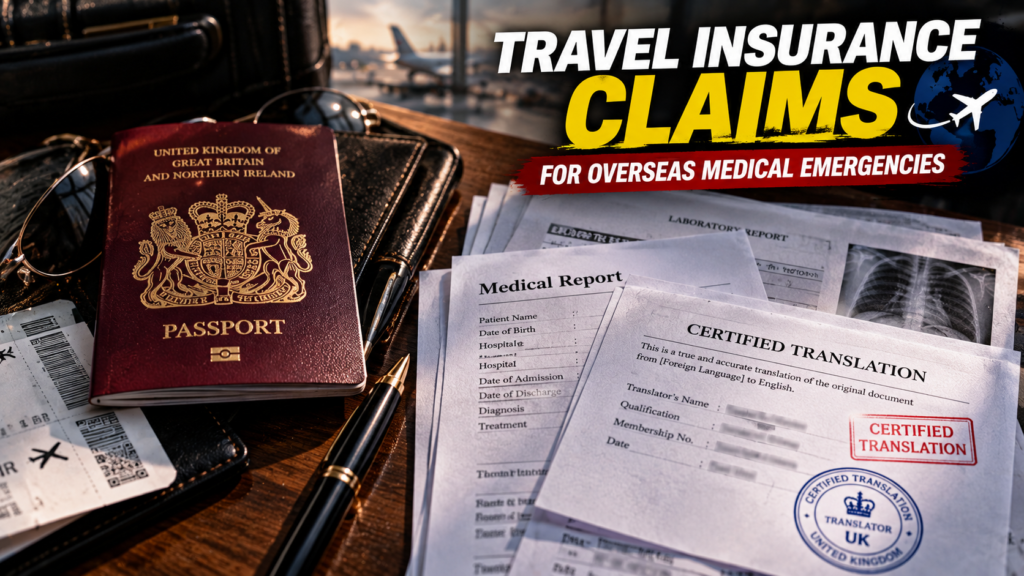
UK travellers constantly conflate travel medical limits with personal accident payouts. This confusion leads to financial ruin. Your standard holiday insurance pays the foreign hospital to patch you up and fly you home. It puts absolutely zero cash in your pocket. If you lose a limb overseas, a capital lump sum is what pays your UK mortgage when you return unable to work. Here is the unvarnished truth about underwriting limits, hidden overseas exclusions, and securing genuine financial protection.
Do You Need Personal Accident Insurance Abroad UK?
To understand why you need dedicated personal accident insurance abroad uk, you must separate the emergency medical response from your long-term financial survival.
When you purchase standard travel insurance for a two-week holiday in Spain, the headline figure is usually highly prominent: “£10 Million Emergency Medical Cover.” Consumers see this massive number and assume they are protected against any financial consequence of an overseas accident. They are entirely mistaken.
The £10 million medical limit exists to indemnify the insurer against exorbitant foreign healthcare costs. If you suffer a catastrophic spinal injury in the United States, your travel insurance provider will use that fund to pay the American hospital directly. They will use it to charter a private air ambulance, complete with a specialized trauma team, to repatriate you back to the UK.
None of that money enters your bank account.
Once the air ambulance lands on UK soil and hands you over to the National Health Service (NHS), the travel insurer’s liability effectively ends. You are now severely disabled, unable to work, and facing a lifetime of lost earnings and expensive home adaptations.
This is where the Personal Accident (PA) element becomes your only lifeline. A PA policy pays a guaranteed, tax-free capital lump sum directly to you if you suffer Permanent Total Disablement (PTD), loss of limbs, or loss of sight. You dictate how that money is spent.
| Feature | Travel Emergency Medical Cover | Personal Accident Cover |
| Who receives the money? | The foreign hospital, the treating doctors, or the medical repatriation aviation company. | You (the policyholder) directly into your UK bank account. |
| What does it cover? | Surgical interventions, hospital bed fees, prescription drugs abroad, and the flight back to the UK. | A capital cash injection to compensate for a life-altering permanent injury or accidental death. |
| Example Payout Limit | £5,000,000 to £10,000,000 (To cover worst-case US healthcare costs). | £50,000 to £500,000 (Depending on your chosen capital sum). |
| When does the support end? | The moment you are safely returned to the UK and admitted to an NHS facility. | It pays out after your medical prognosis is confirmed, securing your long-term future in the UK. |
The Pathetic Limits of Travel Insurance PA Add-ons
You might look at your travel insurance schedule and argue that it already includes a “Personal Accident” section.
Read the fine print.
While the medical cover boasts millions in protection, the PA add-on buried inside standard UK holiday insurance is notoriously stingy. Most high-street travel policies cap their personal accident payout at a token £10,000 to £25,000.
If you are a high-earning professional who is permanently paralyzed in a skiing accident in France, £10,000 is an insult. It will not even cover the cost of a high-end customized wheelchair, let alone replace decades of lost salary or fund the £40,000 required to retrofit your UK home with ground-floor wet rooms and ramp access.
Relying on a £15,000 travel insurance add-on to protect your family’s future is a severe miscalculation. If you want genuine protection, you require a standalone UK personal accident policy that offers global coverage with a capital sum of £100,000 or more.
The Global Health Insurance Card (GHIC) Illusion
Following Brexit, the EHIC was replaced by the UK Global Health Insurance Card (GHIC). Many travellers assume carrying this card negates the need for comprehensive insurance within Europe.
The GHIC provides you with the right to access state-provided healthcare in European Union countries on the same terms as a local resident. If local residents pay a subsidised fee for a doctor’s consultation, you pay that exact same fee.
The GHIC does not cover private medical healthcare. It does not cover mountain rescue in the Alps. It absolutely does not cover medical repatriation flights back to the UK. Crucially, the GHIC does not contain any personal accident provision whatsoever. If you lose an eye in an accident in Italy, the Italian state healthcare system will treat the wound, but neither the Italian government nor the UK government will hand you a compensation cheque for your permanent disability.
The 30-to-90 Day Duration Cap for Digital Nomads
The rise of remote work has created a dangerous insurance void for digital nomads and extended backpackers.
If you hold a premium, standalone UK personal accident policy, it will typically provide “Worldwide Cover.” However, insurers meticulously manage their risk exposure through duration caps.
A standard annual multi-trip policy or a standalone PA policy usually restricts individual trips to a maximum number of consecutive days outside the UK. This cap is typically set at 30, 60, or 90 days.
If your policy has a 60-day limit, and you suffer a catastrophic injury on day 61 of your backpacking trip through South America, your policy is entirely void. The underwriter will check your passport entry stamps and your flight itineraries. Once they prove you breached the consecutive day limit, the claim will be aggressively denied. If you intend to travel long-term, you must declare this to your broker and purchase a specialized “Backpacker” or “Long-Stay” extension.
The Southeast Asia Moped and Alcohol Traps
Underwriters deny hundreds of claims every single year from British tourists injured in Thailand, Vietnam, and Bali. The root cause is almost always the same: mopeds and alcohol.
Insurance companies require you to abide by the local laws of the foreign country and the licensing laws of the UK. If you rent a 125cc scooter in Southeast Asia, you must hold a valid UK motorcycle licence (Category A, A1, or A2) and an International Driving Permit (IDP) if the host nation requires it. A provisional UK licence with a CBT certificate is completely invalid outside the United Kingdom.
If you crash a moped in Bali and suffer a severe brain injury, the insurer will immediately demand a copy of your DVLA driving licence. If you are not legally licensed to ride that specific capacity of motorcycle, they will deny the medical repatriation and deny the personal accident lump sum.
Furthermore, intoxication clauses are rigidly enforced.
If you suffer a severe fall from a balcony in Spain or are involved in a road traffic collision, the foreign hospital will draw blood. If the toxicology report confirms you were heavily intoxicated by alcohol or illegal narcotics at the time of the incident, the insurer will invoke the substance abuse exclusion. They will not subsidize deeply reckless behavior.
| Activity / Scenario | Covered by Standard PA? | What You Need to Do to Get Covered |
| Riding a 125cc Moped Abroad | Rarely (Unless fully licensed). | You must hold a full UK motorcycle licence, wear a crash helmet, and ensure the policy doesn’t explicitly exclude two-wheeled motorized vehicles. |
| Winter Sports (Off-Piste Skiing) | No (Standard policies exclude this). | Purchase a specific “Winter Sports” premium add-on that explicitly covers off-piste activities with a qualified guide. |
| Scuba Diving (Below 30 metres) | No. | Declare your PADI certification level to the broker and purchase an extreme sports extension. |
| Injured While Intoxicated | Never. | There is no premium add-on for intoxication. Drink responsibly or void your entire financial safety net. |
| Manual Labour / Working Abroad | No (Excludes Class 3/4 occupations). | Standard PA covers office work or leisure. If you are doing manual farm work in Australia, you need a specialist occupational policy. |
Actionable Walkthrough: How to Claim for an Accident Overseas
Filing a successful personal accident claim from a foreign jurisdiction is a hostile, highly bureaucratic process. If you survive a severe accident abroad, you must execute a strict evidentiary protocol to prevent the underwriter from dismissing your case.
Step 1: Seek Immediate Treatment & Inform the UK Broker
Your physical stabilization is the priority. However, the moment you are medically capable (or a traveling companion can act on your behalf), you must contact the 24-hour emergency assistance line listed on your insurance documents. Most UK underwriters mandate a strict 30-day notification window. If you wait until you fly home three months later to casually mention you lost a finger, the insurer will reject the claim due to late notification prejudice.
Step 2: Obtain Official Police and Medical Reports
Verifiable evidence is mandatory. If you are involved in a road traffic collision, an assault, or a severe accident in a public space, you must obtain a formal police report before you leave the country. Do not rely on local authorities to email it to you later.
Simultaneously, you must request your complete medical file from the treating foreign hospital prior to discharge. You need the admission notes, the surgical reports, the X-rays, and the formal discharge summary signed by the attending consultant.
Step 3: The Nightmare of Certified Translations
UK insurance claims handlers and their retained medical experts do not read Thai, Spanish, or Greek.
If you submit a 50-page medical dossier from a hospital in Bangkok, the insurer will not process the claim. They will demand that the documents be translated into English by an officially certified legal translator.
This is a hidden cost of claiming overseas. The claimant is almost always responsible for paying the translation fees out-of-pocket before the insurer will even look at the file. A certified medical translation can cost hundreds of pounds. Secure the documents immediately, but be prepared to fund the translation process yourself upon returning to the UK.
Step 4: The Final UK Medical Assessment
Even with perfectly translated foreign medical records, a UK personal accident insurer will rarely issue a six-figure Permanent Total Disablement payout based solely on a foreign doctor’s word.
Once you are repatriated to the UK, your insurer will mandate that you attend an independent medical examination with a UK-registered specialist (such as an orthopedic surgeon or neurologist). This UK expert will assess your permanent prognosis. Only when the UK specialist confirms that your injuries meet the strict contractual definitions of the policy schedule will the tax-free capital sum be released into your bank account.
Do not assume your domestic insurance effortlessly stretches across international borders. Before you board a flight, audit the exact wording of your schedule of benefits, confirm that your planned activities are not buried in the exclusions list, and verify precisely how many consecutive days you are permitted to remain outside the United Kingdom.