
Imagine you are enjoying a crisp Sunday morning hack through the beautiful British countryside. Your horse is moving perfectly, the weather is clear, and everything feels right. Suddenly, a tractor engine backfires from an adjacent field. Your horse completely panics, spins violently, and you are thrown forcefully onto the hard tarmac of the country lane.
The physical pain of a broken pelvis or a shattered collarbone is immediate. However, as the ambulance arrives and you are taken to A&E, a secondary, entirely different kind of panic sets in. You will be off work for months. You have mortgage payments to meet, household bills to pay, and the ongoing costs of your horse’s livery and feed to cover.
You breathe a small sigh of relief, remembering you recently purchased insurance to protect your income. But a terrifying question suddenly crosses your mind: does your standard personal accident policy actually cover equestrian activities, or have you just been riding entirely uninsured?
For thousands of equestrians across the United Kingdom, this is a dangerous grey area. Misunderstanding the fine print of your coverage can lead to financial devastation. In this comprehensive guide, we will explore exactly when a personal accident policy protects you around horses, why standard cover often fails riders, and how to ensure your financial safety net is truly watertight.
Table of Contents
The Short Answer: Does a standard personal accident policy cover equestrian activities?
The equestrian world is incredibly diverse, ranging from occasional riding school lessons to professional yard management. Because of this, the answer to whether your personal accident policy covers you is rarely a simple “yes” or “no.” It depends entirely on the specific terms and conditions set by your chosen insurance provider.
However, as a general rule within the UK insurance market, a basic, off-the-shelf personal accident policy designed for the average office worker will not automatically cover injuries sustained from horse riding.
The insurance industry relies on statistical risk. Working with or riding half-tonne flight animals carries an inherently higher risk of severe injury compared to playing a game of golf or going for a jog. Because of this increased statistical danger, many standard insurance providers classify horse riding as a “hazardous pursuit” or an “extreme sport.”
If your current personal accident policy includes a blanket exclusion for hazardous pursuits, and you fail to explicitly declare that you ride horses, any claim you make following a rotational fall or a bad kick will be instantly rejected. You must always read the policy schedule to see exactly how your provider classifies equestrian activities.
Read our page on What is a personal accident policy and how does it work?]
Riding vs. Working: How insurers view equestrian risks
Not all interactions with horses are viewed equally by underwriters. Insurers separate equestrian activities into distinct categories of risk. Your personal accident policy will treat you very differently depending on whether you are a weekend hacker or a full-time farrier.
Leisure Riding (Hacking, Flatwork, and Schooling)
If you only ride for pleasure at the weekends, participate in basic flatwork schooling, or go for quiet hacks, it is usually quite easy to find coverage. Many providers will allow you to add standard leisure riding to a personal accident policy for a very small additional premium. Some premium policies may even include standard hacking as part of their baseline cover, provided you do not compete.
High-Risk Disciplines (Eventing, Hunting, and Show Jumping)
The moment you add speed and solid obstacles to the mix, the risk profile changes dramatically. If you participate in cross-country eventing, point-to-pointing, fox hunting, or competitive show jumping, a standard personal accident policy will almost certainly exclude you.
To be covered for these high-adrenaline disciplines, you must specifically declare them during your application. You will likely need to purchase a specialist extreme sports add-on or seek out a dedicated equestrian insurance broker to build a bespoke package.
Working with Horses (Grooms, Instructors, and Farriers)
If you derive your primary income from working with horses, the situation changes entirely. Freelance grooms, riding instructors, yard managers, and farriers face physical risks not just in the saddle, but on the ground.
If you are a self-employed equestrian professional, you cannot rely on a generic personal accident policy. You need a robust, occupation-specific income protection plan. This ensures that if you are crushed in a stable or kicked while loading a difficult horse, your replacement income starts paying out immediately, compensating for the lack of Statutory Sick Pay (SSP).
ead the GOV.UK guidelines on health and safety when working with horses
Common Equestrian Exclusions in a Personal Accident Policy
Even if you have specifically purchased an equestrian-friendly personal accident policy, insurance providers still outline strict rules regarding your behaviour. If you breach these rules, your claim will be voided.
Here are the most common exclusions riders must be aware of:
1. Not Wearing Appropriate Safety Gear
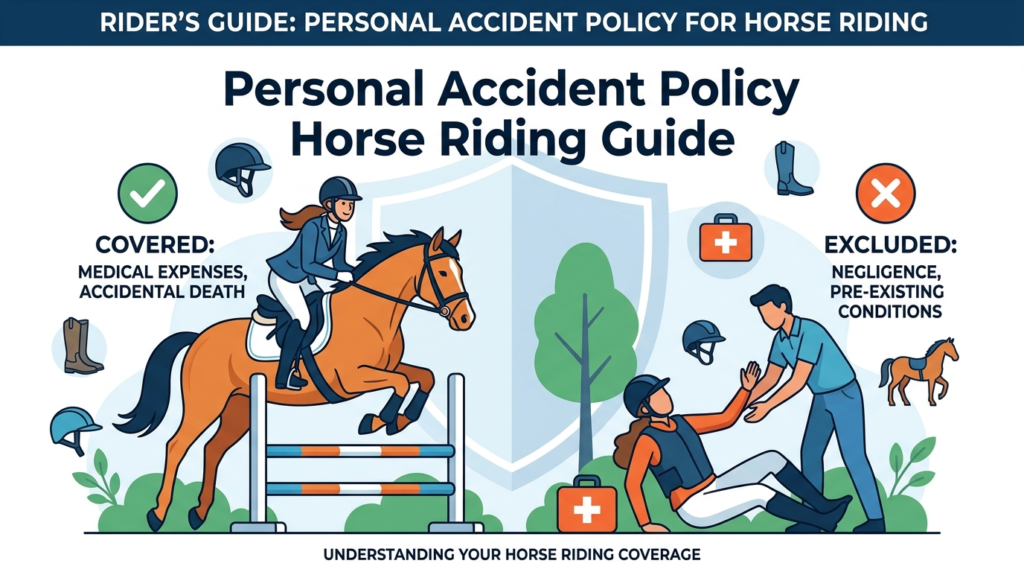
The most frequent reason for a rejected equestrian claim is the failure to wear standard safety equipment. Every UK personal accident policy that covers riding will stipulate that you must wear a riding hat that meets current British equestrian safety standards (such as PAS 015 or VG1) whenever you are mounted. If you suffer a traumatic brain injury while riding bareback in a baseball cap, your claim will be denied due to negligence.
2. Professional Racing and Point-to-Pointing
Unless you are using a highly specialized broker, almost every standard personal accident policy absolutely excludes professional horse racing, point-to-pointing, and training racehorses. The speeds and risks involved in the racing industry are simply too high for mainstream insurers to underwrite without specialized risk assessments.
3. Pre-existing Injuries and “Rider’s Back”
Equestrians are notoriously tough, often riding through minor injuries. However, if you have a documented history of chronic lower back pain (often referred to as “rider’s back”) or a previously dislocated shoulder, you must declare this when taking out your personal accident policy. If you fall and aggravate an undeclared pre-existing condition, the insurer will refuse to pay for your time off work.
What if I am a member of the British Horse Society (BHS)?
This is a massive point of confusion for thousands of UK riders. If you hold BHS Gold Membership, you receive excellent insurance benefits as part of your annual subscription. Many riders mistakenly believe this means they do not need an independent personal accident policy.
This is a dangerous misconception. BHS Gold Membership primarily provides Public Liability Insurance (up to £30 million). This protects you if your horse kicks a parked car or injures a member of the public, and you are sued for damages.
While BHS membership does include a basic personal accident element, it is extremely limited. It generally only provides:
- A lump sum for accidental death.
- A lump sum for permanent total disablement (e.g., loss of a limb or sight).
- Small contributions towards emergency dental work.
Crucially, the BHS cover does not typically provide a weekly or monthly replacement income if you are temporarily signed off work with a broken leg or a fractured pelvis. To protect your monthly salary and ensure your mortgage is paid while you recover, you absolutely still need a dedicated, standalone personal accident policy.
View the official British Horse Society (BHS) membership insurance terms
How to ensure your personal accident policy protects your riding lifestyle
Do not wait until you are sitting in a hospital waiting room to find out if your insurance actually covers your weekend hobbies. Follow these simple steps today to guarantee your financial safety net is secure.
Step 1: Read your current policy schedule
Locate the documents for your existing personal accident policy or income protection plan. Navigate to the “Exclusions” or “Hazardous Pursuits” section. Look for any mention of “equestrian activities,” “horse riding,” or “animal handling.”
Step 2: Contact your provider directly
If the wording in your personal accident policy is vague or confusing, do not guess. Call your insurance provider’s customer service team. Ask them directly: “If I am temporarily signed off work due to a fall from a horse while hacking, will this policy pay out my weekly benefit?” Ask them to confirm their answer in writing via email.
Step 3: Upgrade or switch policies
If your current provider confirms that riding is excluded, you have two choices. You can either ask them to add a hazardous pursuits upgrade to your existing personal accident policy for an additional fee, or you can cancel the policy and move to a specialist provider who understands the equestrian lifestyle.
Read our guide on How to switch your personal accident insurance provider
Frequently Asked Questions (FAQs)
1. Does a personal accident policy cover my horse’s vet bills if we fall together?
No. A personal accident policy is strictly designed to protect human financial interests and human income. If you and your horse are both injured in a rotational fall, your policy will pay your replacement income, but you will need a completely separate “Equine Insurance” policy to cover the surgical and veterinary costs for your horse.
2. Am I covered if I am injured while lunging or handling a horse on the ground?
Usually, yes. If you have secured an equestrian-friendly policy, the cover generally extends to all aspects of horse care, not just riding. Groundwork can be incredibly dangerous. If you are kicked while picking out hooves, trampled while leading a spooky horse in from the field, or crushed in a stable door, your policy should trigger, provided the injury leaves you unable to work.
3. Will my personal accident policy pay out if I fall off while riding abroad?
This depends entirely on the geographical limits set by your provider. A standard UK personal accident policy usually covers you within the borders of the United Kingdom. If you are planning a riding holiday in Spain or a ranch holiday in America, you must inform your insurer. You may need to purchase specific travel insurance with an extreme sports add-on to ensure you are covered overseas.
4. Do I need this insurance if I only ride horses at a licensed riding school?
Yes, it is still highly recommended. While licensed UK riding schools have their own rigorous public liability insurance, that only protects you if the school was legally negligent (e.g., they put you on a dangerously unbroken horse, or their tack snapped due to poor maintenance). If you simply lose your balance and fall off a perfectly safe horse, the riding school is not at fault, and their insurance will not pay your lost wages. You need your own policy for that.
5. What is the “deferment period” and how does it affect riders?
The deferment period is the waiting time between the date of your riding accident and the date your policy begins paying your replacement income. If you have no savings and rely entirely on your weekly wage, you should choose a short deferment period (e.g., 7 or 14 days). If your employer provides a generous sick pay package for the first month, you can choose a 30-day deferment period, which will make your monthly insurance premiums significantly cheaper.
Conclusion
Equestrianism is more than just a sport; it is a dedicated, time-consuming, and expensive lifestyle. As riders, we spend thousands of pounds on bespoke saddles, premium feeds, and top-tier veterinary care to ensure our horses are protected from every possible danger. Yet, we frequently forget to protect the most important asset in the partnership: ourselves.
Assuming that a generic, budget-friendly personal accident policy will automatically cover the inherent dangers of riding or handling horses is a massive financial gamble.
Take control of your financial security today. Review the fine print of your documents, declare your riding activities honestly to your provider, and build a safety net that genuinely reflects the reality of your life. By securing the right personal accident policy, you can enjoy every hack, every schooling session, and every competition with total peace of mind, knowing that if the worst does happen, your home, your family, and your horse’s upkeep are fully protected.