
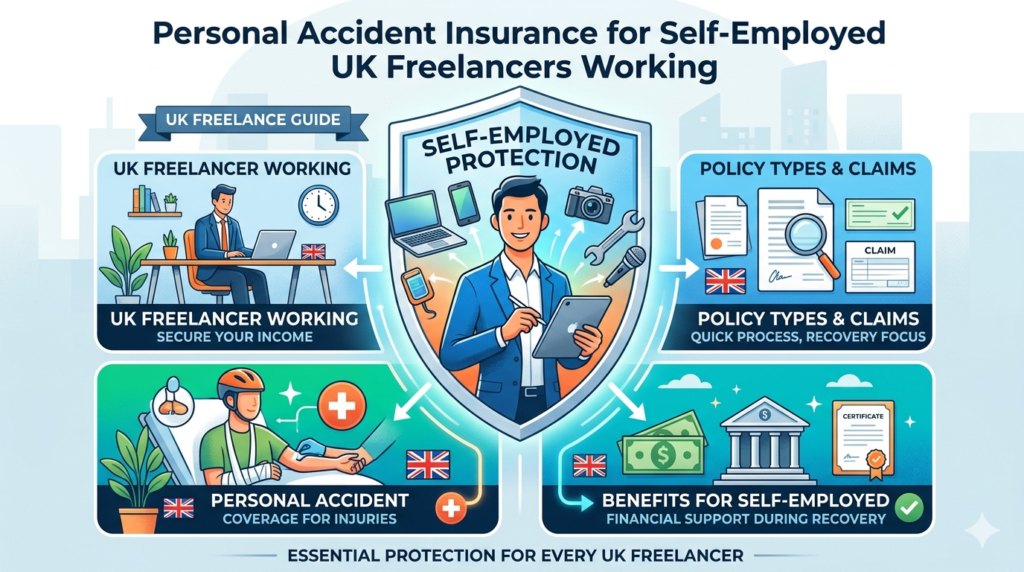
Imagine you are an independent plumber in the middle of a massive bathroom renovation, or a freelance graphic designer staring down three strict client deadlines. You are entirely your own boss, which brings incredible freedom and flexibility. However, one Tuesday morning, a nasty slip on a wet floor or a sudden road traffic collision changes everything. You sustain a fractured wrist and a severe concussion.
Suddenly, your ability to work simply vanishes. The physical pain is immediate, but a terrifying secondary anxiety quickly follows: how will you pay your mortgage? Who will cover your business lease, your van finance, and your household energy bills while you are recovering?
For traditional employees, a robust HR department and sick leave policies usually step in. For you, the safety net is completely non existent. When you work for yourself, no work means no pay. This is precisely why securing personal accident insurance for self employed professionals is arguably the most vital business decision you will ever make.
In this comprehensive guide, we will break down the absolute necessity of personal accident insurance for self employed workers in the UK. We will explore how it bridges the terrifying gap left by state benefits, exactly what these policies cover, and how to tailor a policy perfectly to your unique freelance or contracting lifestyle.
Table of Contents
What is personal accident insurance for self employed workers?
At its core, this financial product is a highly specific protective shield for your income. It is a contractual agreement where, in exchange for a monthly premium, an insurer agrees to pay you a replacement income or a lump sum if you are unable to work due to an unforeseen bodily injury.
Unlike public liability insurance, which protects you if you accidentally injure a client or damage their property, this cover is entirely about protecting you.
When we talk about personal accident insurance for self employed individuals, we are looking at a policy that pays out directly to your personal bank account. It is designed to ensure that a broken leg or a severe back injury does not force you into crippling debt, allowing you to focus entirely on your physical rehabilitation.
If you are unfamiliar with the foundational mechanics of how these policies generally trigger, we highly recommend reviewing our core introductory guide first.
Read our pillar page on What is personal accident cover
The brutal financial reality: Why standard safety nets fail
The UK economy relies heavily on its massive army of independent workers. From sole traders to limited company directors, the self-employed sector is the backbone of the nation. Yet, the financial protections offered by the state to this exact group are notoriously weak.
To understand the true value of personal accident insurance for self-employed people, you must first understand the severe limitations of the alternatives.
The total absence of Statutory Sick Pay (SSP)
If an employed person falls off a ladder at home and cannot go to the office, they are usually entitled to Statutory Sick Pay (SSP). While SSP is quite low (currently £116.75 per week for the 2024/2025 tax year), it is at least something.
If you operate as a sole trader, you are legally not entitled to a single penny of SSP. Your income instantly drops to zero the second you stop working.
Relying on Universal Credit
Without SSP, an injured sole trader must navigate the complex and often heavily delayed Universal Credit system, or apply for Employment and Support Allowance (ESA). These state benefits offer a bare-minimum survival rate. They will not cover the average UK mortgage, let alone your ongoing business commitments like software subscriptions, tool hire, or commercial vehicle insurance.
Relying on state welfare instead of personal accident insurance for self-employed protection is a massive gamble that frequently leads to severe debt.
Read the official GOV.UK guidelines on financial support and benefits for the self-employed
The core benefits of personal accident insurance for self-employed individuals
Investing in a proper policy provides far more than just a simple cheque; it provides absolute business continuity and profound peace of mind. Here is why buying personal accident insurance for self employed workers is practically mandatory for a secure career:
- Protects the Family Home: By replacing a substantial percentage of your normal earnings, you can guarantee that your rent or mortgage payments are met on time, every time.
- Maintains Business Viability: You can use your weekly payouts to keep your business afloat. You can continue paying for your business mobile, your website hosting, and your vital trade memberships so you have a business to return to.
- Reduces Recovery Stress: Financial panic actively slows down physical healing. Knowing you have personal accident insurance for self employed cover allows you to rest properly without rushing back to physical labour before your body is ready.
- Covers Fixed Outgoings: Whether it is a lease on a commercial premises or monthly vehicle finance, these strict legal contracts do not care if you have broken your collarbone. They still demand payment.
What does personal accident insurance for self-employed professionals cover?
When looking at a policy document, the financial payouts generally fall into two highly distinct categories. Understanding the difference is crucial when configuring your personal accident insurance for self employed package.
>>Is Personal Accident Insurance Tax Deductible for Sole Traders?
1. Weekly Payouts (Temporary Total Disablement)
This is the lifeblood of the policy and the primary reason most self-employed people make a claim. Temporary Total Disablement (TTD) applies when a doctor confirms you are temporarily entirely unable to perform your normal daily trade.
- The Goal: To replace your weekly wage so you can survive the downtime.
- The Mechanism: The insurer deposits a regular tax-free sum into your account every week or month.
- The Duration: A standard policy for personal accident insurance for self employed tradespeople will typically pay this out for a maximum of 12 months or 24 months per claim.
2. Lump Sum Payouts
These are reserved for catastrophic, life-altering situations from which you will never fully recover. If you suffer a permanent trauma, a weekly payout for 12 months is not enough. You need a massive injection of cash to clear debts and adapt your home.
Typical triggers for a lump sum include:
- Permanent Total Disablement (PTD): You are severely injured and can never work again in any capacity.
- Loss of Limbs or Sight: The permanent physical loss of an arm, leg, hand, or total loss of vision.
- Accidental Death: A guaranteed lump sum paid to your family to replace your lost future earnings if you are tragically killed.
Setting the Deferment Period
When comparing personal accident insurance for self employed limits, the “deferment period” is the most important lever you can pull to adjust your monthly premium costs.
The deferment period is the waiting time between the date you are injured and the date the insurer actually starts paying you. Because you do not have employer sick pay to bridge the gap, choosing the right waiting period is critical.
- 7 Days (Immediate Cover): Your payouts begin just one week after your accident. This is essential for sole traders with zero financial buffer or savings. Because the insurer takes on massive immediate risk, this option carries the highest monthly premiums.
- 14 Days (The Middle Ground): If you have a small emergency fund capable of covering two weeks of basic groceries and utility bills, selecting a 14-day deferment will noticeably reduce your premium.
- 30 Days (For the Prepared): If you have been diligent and built a solid one-month emergency savings pot, choose a 30-day deferment. Why deferment matters in personal accident insurance for self employed contracts is that pushing the risk back to 30 days makes the policy incredibly cheap to maintain.
Calculating your ideal coverage amount
A major pitfall is attempting to insure 100% of your highest grossing month. UK insurers will not allow this. Figuring out the limits for personal accident insurance for self employed earners requires looking at your net profit, not your gross turnover.
Insurers will typically cap your maximum coverage at 60% to 70% of your average gross personal income.
Step-by-step guide to calculating your required payout:
- Calculate strictly essential personal bills. Tally your mortgage, council tax, home utilities, and basic food shopping.
- Add unavoidable business costs. Add the business expenses that you cannot easily pause, such as a van lease, public liability insurance premiums, or commercial rent.
- Add ongoing debt. Include minimum credit card payments or personal loans.
- Create a 10% emergency buffer. Add this to the final total to cover inflation or unexpected recovery costs like private physiotherapy.
Ensure this final required amount does not exceed 60% of your verifiable income (as shown on your SA302 tax calculation). Do not over-insure your personal accident insurance for self employed plan; it is a waste of premium money.
Frequently Asked Questions
1. Is personal accident insurance for self employed tax-deductible?
This is a complex area and you should always consult your accountant. Generally, if you operate as a sole trader and the policy pays out directly to you to replace your personal income, the premiums are not tax-deductible as a business expense. However, because you paid the premium from your post-tax income, any weekly payouts you receive from the policy are usually entirely tax-free.
2. How does personal accident insurance for self employed handle past injuries?
Policies almost universally exclude pre-existing medical conditions. If you have a documented history of severe knee problems, and you subsequently fall and shatter that exact knee, the insurer will heavily scrutinise the claim. You must be completely honest about your medical history during the application process.
3. Can my limited company pay for personal accident insurance for self employed directors?
Yes. If you operate as a Limited Company, the business can pay the premiums for the directors. This is often an allowable business expense for corporation tax purposes. However, it is treated as a “Benefit in Kind” (P11D benefit) for the director, meaning you will personally pay income tax on the value of the premium.
4. Does personal accident insurance for self employed cover weekend sports?
It depends on the sport. Most policies cover standard leisure activities like going to the gym or light jogging. However, if you are injured playing amateur rugby, skiing, or engaging in extreme sports, a standard policy will likely reject the claim. You must declare “hazardous pursuits” and potentially pay a small premium increase to ensure you are covered both at work and at play.
5. What documents are needed when claiming on personal accident insurance for self employed policies?
Because you do not have an employer to verify your absence, the burden of proof rests on you. You will absolutely need a formal “fit note” from your GP or A&E discharge papers proving your injuries. To prove your financial loss, the insurer will usually request your most recent finalized Self-Assessment tax return (SA302) or your finalized limited company accounts.
Read our step-by-step guide on How to make a claim correctly
Conclusion
Stepping out on your own to build a business is an incredibly brave and rewarding path. However, the absolute freedom of being self-employed comes heavily paired with total financial responsibility. If you fall, there is no corporate safety net waiting to catch you.
Securing personal accident insurance for self employed peace of mind is not a luxury; it is a fundamental pillar of your business survival strategy. It ensures that a momentary lapse in concentration on a job site, or a sudden road traffic accident, does not completely unravel the livelihood you have worked so hard to build.
Take a realistic look at your monthly outgoings and your savings buffer today. Calculate exactly what you need to survive, choose an appropriate deferment period, and don’t wait to buy personal accident insurance for self employed cover. Protect your income, protect your family, and secure the future of your independent career.
Pingback: 7 Best Ways to Compare Personal Accident Insurance Quotes (2026)