
Receiving a substantial financial settlement after a devastating accident can bring a profound sense of relief. After months, or sometimes years, of dealing with intense physical pain, medical assessments, and complex legal battles, the payout finally arrives. It is supposed to represent a fresh start a vital financial foundation to help heal, adapt, and move forward with your life.
However, for many individuals in the United Kingdom, that initial wave of relief is quickly replaced by an unexpected wave of financial anxiety.
If you currently rely on state benefits to support your daily living costs, or if you think you might need to apply for local authority care funding in the future, a lump sum of compensation can feel like a ticking financial time bomb. Without careful planning, the arrival of your settlement money can trigger the immediate suspension of your means-tested benefits.
This is where an essential, highly effective legal mechanism comes into play. Setting up a personal injury trust allows you to completely isolate your compensation money, ensuring it is treated as invisible by the Department for Work and Pensions (DWP).
In this comprehensive, expert-led guide, we will break down absolutely everything you need to know about setting up a personal injury trust, how it completely safeguards your financial future, the strict rules governing its maintenance, and exactly what you are allowed to spend the money on.
Table of Contents
The Core Problem: The DWP Capital Limits
To fully understand why a personal injury trust is an absolute necessity, we first have to take a look at the rigid rules that govern means-tested benefits in the United Kingdom.
The DWP maintains strict limits on the amount of personal capital or savings an individual or a couple can hold before their state support is reduced or terminated entirely. If your total personal savings cross these thresholds, the state views you as self-sufficient, regardless of the fact that your money came from an injury payout meant to cover lifelong care needs.
The Standard Means-Tested Capital Thresholds:
- Under £6,000: Your means-tested benefits are completely unaffected.
- Between £6,000 and £16,000: The DWP applies a tariff income. For every £250 (or part thereof) you hold over the £6,000 limit, your monthly benefit payments are systematically reduced.
- Over £16,000: Your entitlement to means-tested benefits drops to absolute zero. You are completely cut off from state financial support.
Imagine receiving a £50,000 settlement to modify your home after a severe spinal injury, only to find that your Universal Credit and Housing Benefit are immediately stripped away because your bank account balance exceeds £16,000. You would be forced to spend your hard-won compensation on everyday rent and groceries—funds that were specifically meant to adapt your living space or pay for private rehabilitation.
Thankfully, the law provides a clear, completely legal way to bypass this issue. By placing your settlement inside a personal injury trust, the capital is formally ring-fenced. The state can no longer count that money toward your £6,000 or £16,000 capital limits.
What Exactly Is a Personal Injury Trust?
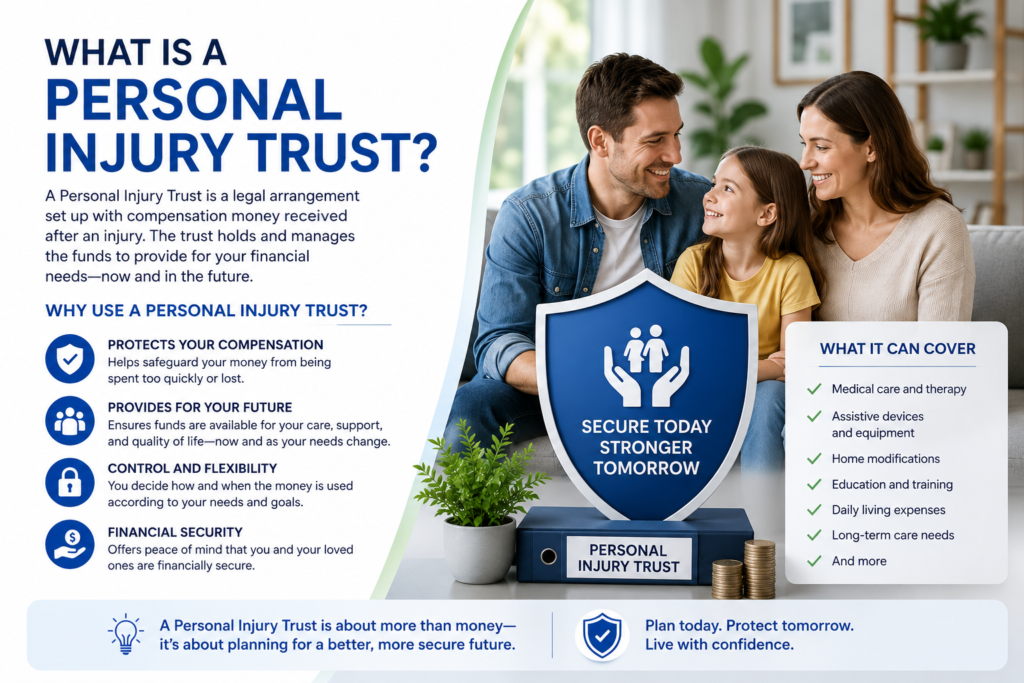
In purely technical terms, a personal injury trust is a binding legal arrangement where you appoint trusted individuals (known as Trustees) to take formal, legal ownership of your compensation funds. The money is held within a specialized trust bank account, entirely separate from your day-to-day personal checking or savings accounts.
While the Trustees hold legal control over the account, they do not own the money for their own personal gain. They are legally bound by a deed to hold and manage those assets strictly for your benefit. You are the “Beneficiary.”
Because the capital is no longer held directly in your personal name, the DWP, local councils, and HMRC view the personal injury trust as an independent financial entity. It acts as an impenetrable shield around your settlement.
The 52-Week Grace Period: A Crucial Warning
A major misconception in the UK is that you have to set up a trust the exact day your settlement clears. The law actually provides a 52-week grace period.
From the exact date you receive your very first interim or final compensation payment, the DWP is legally required to ignore that capital for up to one full year. This rule exists to give injured individuals time to arrange their affairs.
However, do not let this grace period cause you to delay. Setting up specialized trust bank accounts and drafting legal deeds takes time. If the 52-week window closes and your funds are still sitting in a standard personal savings account, your means-tested benefits will be stopped immediately. Activating your personal injury trust early ensures a seamless transition.
Which Benefits Are Protected by a Trust?
It is vital to distinguish between means-tested benefits (which look at your financial situation) and non-means-tested benefits (which are paid based on your physical condition, regardless of your wealth).
A personal injury trust is specifically designed to protect means-tested benefits, which include:
- Universal Credit
- Income Support
- Housing Benefit
- Council Tax Support
- Income-related Employment and Support Allowance (ESA)
- Pension Credit
- Jobseeker’s Allowance (Income-based)
What About Non-Means-Tested Benefits?
If you receive Personal Independence Payment (PIP), Disability Living Allowance (DLA), or Attendance Allowance, your capital is irrelevant. You could win millions on the lottery tomorrow, and your PIP payments would continue completely unaltered, as they are based solely on your care and mobility needs.
However, many people who receive PIP also receive Universal Credit or Housing Benefit. If you fall into this blended category, a personal injury trust remains absolutely essential to safeguard the means-tested components of your monthly income.
Personal Injury Trust: What Can I Spend It On?
This is easily the most frequent question I receive from beneficiaries across the UK. There is a widespread, terrified assumption that once your compensation is placed inside a personal injury trust, it becomes locked away, completely out of reach, or restricted only to medical equipment.
This could not be further from the truth. When evaluating a personal injury trust what can i spend it on, the legal reality is that the money can be used for practically anything that enhances your lifestyle, comfort, and general well-being.
The money inside the trust belongs to you. However, to keep the DWP completely satisfied, the way the money is paid out must follow a strict administrative process.
Approved Ways to Use the Money
As long as the purchase directly benefits you, your Trustees can authorize spending on:
- Property and Home Modifications: You can buy a house outright using your trust funds, or pay for major structural changes like wheelchair ramps, wet rooms, or widened doorways.
- Vehicles and Transport: Purchasing a new car, paying for specialist vehicle adaptations, or covering specialized transport costs.
- Holidays and Travel: Booking flights, accommodation, and travel experiences for you, your family, or a required medical carer.
- Education and Technology: Paying for university tuition, specialized training courses, high-end computers, or assistive technology software.
- Medical Treatment and Therapy: Funding private surgeries, long-term physiotherapy, psychological counselling, or alternative therapies not readily available via the NHS.
- Debts and Household Upgrades: Clearing existing credit cards, buying furniture, upgrading household appliances, or purchasing clothing.
The Golden Rule of Trust Spending
To maintain the legal integrity of your personal injury trust, money should never move directly from the trust bank account into your personal everyday bank account.
If your trust bank account transfers £1,000 straight into your standard current account, the DWP will instantly log that £1,000 as personal capital or personal income. This mistake can immediately disrupt your benefit calculations.
Instead, the transaction must happen directly from the trust to the supplier. For example, if you want to buy a new laptop, your Trustees should use the specialized trust debit card to buy it from the retailer directly, or pay the invoice via a direct bank transfer from the trust account. The laptop is delivered to you, your personal bank balance stays completely unchanged, and your benefits remain totally safe.
How to Set Up a Personal Injury Trust: Step-by-Step
Setting up a personal injury trust requires following a precise administrative process. Skipping a single step or using a generic, templated internet deed can cause the structure to fail under a DWP audit.
[Receive Injury Settlement] ➔ [Appoint 2 trusted Trustees] ➔ [Draft Specialist Trust Deed] ➔ [Sign & Execute Deed] ➔ [Open Trust Bank Account] ➔ [Notify DWP & Provide Deeds]
Step 1: Appoint Your Trustees
You need to select individuals you completely trust to manage the account. Most people choose their spouse, adult children, close family members, or lifelong friends.
You must have at least two Trustees, or a professional entity (like a firm of solicitors or an independent accountant). You can also act as a Trustee yourself alongside them, ensuring you maintain a direct voice in how the account operates.
Step 2: Draft the Trust Deed
A specialized legal document must be drawn up. This deed outlines the rules of the trust, explicitly states that the capital originated from a personal injury settlement, and names the Beneficiary and Trustees. It is highly recommended to hire a specialist UK solicitor to draft this document to ensure it satisfies both HMRC and DWP legal standards.
Step 3: Execute the Deed
Once the deed is drawn up, all Trustees must sign the document in the presence of an independent witness. This formalizes the legal existence of your personal injury trust.
Step 4: Open a Specialized Trust Bank Account
This can often be the most frustrating step. You cannot use a standard current account. You must open a designated “Trustee Account” or “Client Account.”
Major UK high-street banks offer these accounts, but their setup times can be lengthy. The compensation check or bank transfer from your personal injury lawyer must be paid directly into this new account.
Step 5: Notify the DWP
Once the account is fully open and funded, your solicitor will send a copy of the executed trust deed to the DWP and your local authority. This serves as formal, legal notification that your capital is now ring-fenced, allowing your means-tested benefits to continue without interruption.
Frequently Asked Questions (FAQs)
Can I set up a personal injury trust if I am not currently on benefits?
Yes, absolutely. Even if you do not currently claim means-tested benefits, you may need to apply for them in the future due to health changes or shifting economic circumstances. Furthermore, if you ever require residential care or local authority support in your older age, a personal injury trust ensures your compensation payout cannot be seized by the local council to cover those steep care home fees.
How much does it cost to set up a trust in the UK?
The cost varies depending on the complexity of your settlement and the legal firm you choose. On average, a specialist UK solicitor will charge anywhere between £500 and £1,500 plus VAT to draft and execute a standard Bare Trust deed. This upfront cost is minor compared to losing thousands of pounds in monthly benefit support.
What is the most common type of trust used for injury payouts?
The absolute most common type is a Bare Trust. In a Bare Trust structure, you maintain absolute entitlement to all the capital and income generated within the account. The Trustees simply handle the administrative duties. It is highly favored because it is simple to manage and carries straightforward tax implications.
How does a personal injury trust affect my taxes?
If you utilize a standard Bare Trust, the tax position remains entirely neutral. HMRC treats the money as if it still belongs directly to you. Any interest generated by the trust bank account, or dividends earned from trust investments, are reported on your personal self-assessment tax return and taxed at your standard personal tax rate.
Conclusion: Safeguarding Your Financial Future
Navigating life after a severe physical trauma is challenging enough without the added stress of a bureaucratic battle with the DWP. Compensation payouts are not a financial windfall or an unexpected lottery win; they are legally awarded, vital financial resources designed to piece your life back together and provide long-term security.
Allowing that essential financial buffer to be consumed by everyday expenses because your means-tested benefits were cut off is a tragic, yet entirely preventable, situation.
By taking proactive steps to set up a personal injury trust within your 52-week grace period, you build an ironclad wall around your settlement. It gives your family total peace of mind, ensures your state support continues completely uninterrupted, and allows you to focus 100% of your energy on your long-term rehabilitation, recovery, and happiness.