
As the founder of Personal Accident UK, I frequently speak with business owners, HR directors, and operations managers who are reviewing their annual corporate insurance renewals. They often see a line item for employee protection and ask me the exact same question: what is group personal accident insurance, and do I really need to pay for it?
When you run a business in the United Kingdom, protecting your workforce is both a moral and a legal duty. However, the world of commercial insurance is packed with overlapping terms. Many employers confuse mandatory legal covers with optional employee benefits, leaving them either dangerously exposed to financial risk or overpaying for redundant policies.
If you want to attract top talent and protect your company’s bottom line from the chaos of long-term staff absences, understanding this specific policy is critical. In this comprehensive guide, we will break down exactly how this protection works, what it actually covers, and why it is a game-changer for modern UK businesses.
Table of Contents
Understanding the Basics: The Definition
To answer the question of what is group personal accident cover, we must look at who buys it and who benefits from it.
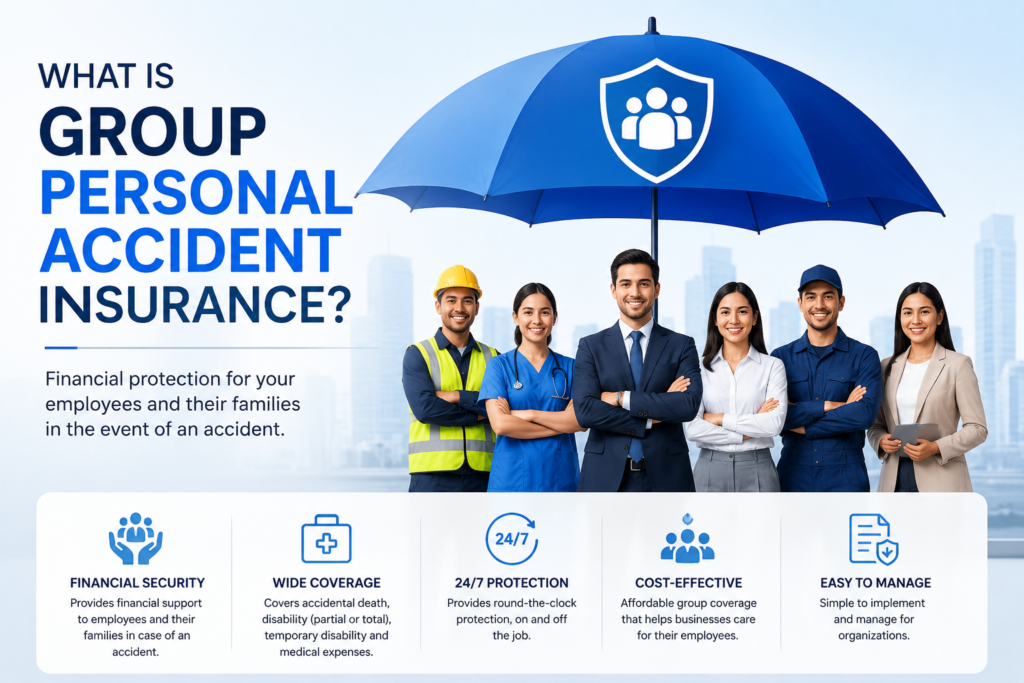
Simply put, a Group Personal Accident (GPA) policy is a single commercial insurance contract purchased by an employer to cover a defined group of people—usually their entire workforce, a specific board of directors, or designated teams.
Unlike a standard individual policy that you might buy for yourself, the company pays the premium. If an employee suffers a severe injury, a permanent disability, or tragically dies as a result of an accident, the policy pays a substantial, tax-free financial sum.
Depending on how the business structures the trust, this payout can either go directly to the injured employee (or their family) to help them survive financially, or it can be paid directly to the business to cover the massive costs of hiring a temporary replacement.
Employers’ Liability vs. Group Personal Accident
This is where the most dangerous confusion lies. Many business owners believe they do not need group accident cover because they already hold Employers’ Liability (EL) insurance.
These are entirely different financial tools that serve completely different purposes:
- Employers’ Liability (EL): This is a strict legal requirement in the UK. If an employee is injured because of the company’s negligence (e.g., you failed to fix a broken ladder, and they fell), EL covers the company’s legal defence costs and the resulting compensation payout. It exists to protect the business from being sued.
- Group Personal Accident: This is a “no-fault” policy. It does not matter who caused the accident. If an employee falls off their own bicycle on a Sunday afternoon while at the park, a comprehensive GPA policy will still pay out. It exists to provide a rapid financial safety net without the need for a lengthy, hostile legal battle.
What Does the Policy Actually Cover?
When explaining what is group personal accident protection to my corporate clients, I break the coverage down into two distinct payout structures: Capital Benefits and Weekly Benefits.
1. Capital Benefits (Lump Sums)
These are large, one-off payments designed to compensate for catastrophic, life-altering events. Standard coverage includes:
- Accidental Death: A lump sum (often a multiple of the employee’s salary, such as 2x or 3x) paid to their estate or family if they die in an accident.
- Permanent Total Disablement (PTD): If the employee suffers an injury so severe (like traumatic brain damage or spinal paralysis) that they can never return to work, the maximum policy limit is triggered.
- Loss of Limbs or Senses: Fixed payouts for the permanent loss of an arm, leg, hand, sight in one or both eyes, or total loss of hearing.
2. Temporary Total Disablement (Weekly Benefits)
This is arguably the most useful element for a business. If an employee breaks their leg skiing and cannot work for three months, the policy will pay a weekly sum (typically up to 75% of their gross weekly wage).
This allows the business to continue paying the injured employee their full salary without draining company profits, whilst using the retained business capital to hire a temporary contractor to cover the workload.
Why UK Employers Should Invest in GPA
If you are a business owner wondering if this premium is worth the cost, consider the modern corporate landscape.
Firstly, it is a phenomenal recruitment and retention tool. In a highly competitive UK job market, offering a robust benefits package shows your staff that you genuinely care about their welfare outside of office hours. If an employee asks a recruiter what is group personal accident cover, and the recruiter explains it is a 24/7 safety net provided free by your company, your job offer instantly becomes more attractive.
Secondly, it mitigates severe financial strain. If a key manager is involved in a severe car accident, can your business afford to pay their salary for six months while they recover, whilst simultaneously paying a premium day-rate to a freelance replacement? For most Small and Medium Enterprises (SMEs), that double financial burden is crippling. GPA transfers that exact financial risk to the insurer.
Key Exclusions: What Is Not Covered?
No insurance policy is a blank cheque. Group policies operate on strict risk profiles. To truly understand what is group personal accident insurance, you must read the policy exclusions. Claims will typically be rejected if the employee’s injury was caused by:
- Pre-Existing Medical Conditions: The policy covers unforeseen, external accidents. It does not cover heart attacks, strokes, or injuries caused by a condition the employee already had.
- Intoxication: Injuries sustained while the employee was heavily under the influence of alcohol or illegal drugs are strictly excluded.
- Self-Inflicted Harm: Any intentional self-injury or attempted suicide is not covered.
- Extreme Sports (Without Declaration): If your team frequently engages in high-risk activities (like amateur motorsport or deep-sea diving), you must explicitly declare this to the insurer to ensure those activities are not excluded.
Frequently Asked Questions (FAQs)
What is the group personal accident meaning in simple terms?
In simple terms, group personal accident meaning refers to a single insurance policy bought by an employer to cover a designated group of people (usually their employees). It guarantees a tax-free financial payout if any covered member suffers a serious injury or death caused by an external accident, regardless of who was at fault.
Is group personal accident insurance mandatory in the UK?
No, it is not mandatory. Employers’ Liability (EL) insurance is a strict legal requirement in the UK, but Group Personal Accident (GPA) is an optional, supplementary employee benefit. However, many successful businesses consider it essential for risk management and staff retention.
Are the premiums paid by the business tax-deductible?
Generally, yes. Because group personal accident insurance is considered a legitimate business expense designed to protect the financial stability of the company, the premiums paid are usually treated as an allowable deduction against Corporation Tax. However, it is always recommended to consult your company accountant, as the structure of the policy (whether benefits are paid to the employee or the business) can affect tax status.
Can we cover only certain employees, or does it have to be the whole company?
GPA policies are incredibly flexible. You do not have to cover the entire workforce. You can set up policies that only cover your board of directors, your travelling sales team, or specific high-risk manual workers. You can also vary the payout multiples (e.g., offering directors a 4x salary payout and standard employees a 2x salary payout).
Does it cover staff when they are not at work?
It depends entirely on the policy you choose. You can purchase restricted policies that only cover employees during their commute and contracted working hours. However, the most robust and popular GPA policies provide global, 24/7 protection—meaning if an employee breaks their leg on a weekend holiday in Spain, the policy still pays out.
Conclusion: Securing Your Workforce
Running a successful business requires managing risk on multiple fronts. While mandatory policies protect your company from lawsuits and regulatory fines, a Group Personal Accident policy protects the actual human beings that make your business profitable.
By providing a guaranteed financial safety net that operates 24 hours a day, 365 days a year, you build a culture of immense trust and loyalty. It prevents your company from facing severe cash-flow crises during long-term staff absences and ensures that if the absolute worst happens, your employees and their families are protected from immediate financial ruin.
When you sit down for your next insurance review, ask your broker to provide a quote for group accident coverage. The immense peace of mind it delivers to both you and your workforce is entirely worth the investment.