
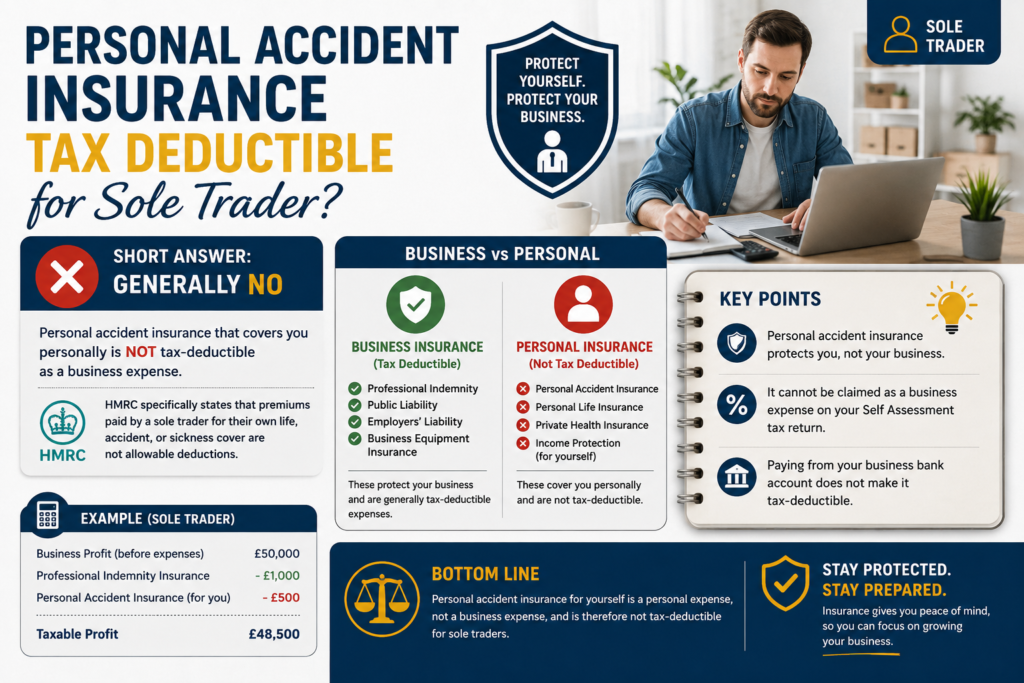
When searching for a personal accident insurance tax deductible sole trader solution, the logic seems obvious. You need your body to work to earn a living, so protecting it feels like a business expense. Unfortunately, HMRC disagrees. Personal accident premiums are a personal expense, not an allowable business deduction.
Here is exactly why the taxman rejects this cost, and how you can manage your premiums without falling foul of an audit.
Personal Accident Insurance for Self-employed Workers
Decoding the Personal Accident Insurance Tax Deductible Sole Trader Myth
Scroll through any thread on r/UKPersonalFinance, and you will see the exact same frustration from independent contractors. A self-employed carpenter relies on their hands. A freelance photographer relies on their eyesight. If an injury prevents them from working, the business immediately ceases to generate revenue.
Therefore, insuring the body that drives the business seems like a perfectly legitimate, entirely necessary commercial expense.
HMRC sees it differently.
The UK tax system does not care about your personal reliance on your physical health. To HMRC, protecting your body is a personal choice, not a statutory business requirement. Unlike a limited company director who might be able to structure certain health covers as a Benefit-in-Kind, a sole trader and their business are viewed as a single legal entity. You are the business. Consequently, personal expenses and business expenses frequently blur, forcing HMRC to apply a very rigid filter to determine what you can deduct from your annual tax bill.
The “Wholly and Exclusively” Test
If you want to understand UK tax law for the self-employed, you must understand the “wholly and exclusively” rule.
For any cost to be considered an allowable business expense, it must be incurred wholly and exclusively for the purposes of the trade. This means the expense cannot have a dual purpose. If a cost provides both a business benefit and a personal benefit, it fails the test. It cannot be deducted from your taxable profits.
This is where personal accident cover fails.
If you break your leg and cannot work, your business suffers. That is the commercial angle. However, a broken leg also stops you from walking your dog, driving your personal car, and playing football on a Sunday. The insurance protects you as a private individual outside of your working hours. Because the policy offers an undeniable personal benefit, HMRC categorizes the premium as a personal expense. You must pay for it out of your own pocket, using post-tax income.
Allowable vs. Non-Allowable Business Insurance
To clarify where HMRC draws the line, we must contrast personal accident cover with other common types of commercial insurance.
When an insurance policy protects the business operations rather than the business owner’s body, HMRC is perfectly happy to let you deduct the premiums from your taxable profit.
| Insurance Type | Allowable Business Expense? | HMRC Rationale |
| Public Liability (PL) | Yes | Protects the business against claims from third parties (e.g., a client tripping over your equipment). Strictly for trade purposes. |
| Professional Indemnity (PI) | Yes | Covers legal costs and damages if your professional advice causes a client financial loss. No personal benefit. |
| Employers’ Liability (EL) | Yes | A legal requirement if you hire staff. It strictly covers employee injuries related to your business operations. |
| Personal Accident (PA) | No | Protects your physical body. Provides a personal benefit outside of working hours, failing the dual-purpose test. |
| Income Protection | No (Usually) | Replaces your personal income. Like PA, it is viewed as a personal safeguard rather than a trade expense for sole traders. |
For a broader view of how to protect your livelihood without making critical taxation errors, explore our comprehensive breakdown in The Complete Self-Employed Insurance Hub.
The Silver Lining: Tax-Free Lump Sum Payouts
The realization that you cannot claim tax relief on your premiums often stings. You are taking the responsible step of protecting your financial future, yet you receive no tax incentive for doing so.
But there is a massive structural advantage to HMRC’s rigid stance.
Because HMRC forces you to pay for your personal accident insurance using post-tax income—meaning you have already paid Income Tax and National Insurance on the money used to buy the policy—they cannot tax you on the way out.
If you suffer a severe injury covered by your schedule of benefits, your insurer will issue a lump sum payment. Whether that payout is £10,000 for a severe fracture or £100,000 for permanent total disablement, that money lands in your bank account entirely tax-free. It does not count toward your annual trading allowance. It does not push you into a higher Income Tax bracket. It is not subject to Capital Gains Tax.
You absorb the cost of the premium upfront, but you reap the full, undiluted financial benefit when catastrophe strikes. In a worst-case scenario where you are desperately relying on that cash injection to keep a roof over your head, a tax-free payout is vastly superior to a taxable one.
How to Handle the Premiums in Your Accounting
Even though the rules are clear, the way you actually process the payments matters during tax season. Mixing personal and business finances is the fastest way to trigger an HMRC headache.
If you have a dedicated business bank account, you should ideally avoid paying your personal accident insurance premiums from it. Set up the direct debit to come straight out of your personal current account. This keeps your bookkeeping clean and prevents your accountant from having to untangle non-allowable expenses at the end of the financial year.
If you do choose to pay the premium from your business account for convenience, you must record the transaction correctly. You cannot categorize it under “Insurance” or “General Expenses” on your Self Assessment tax return. Instead, the payment must be logged as “Drawings.”
Drawings represent money taken out of the business for personal use. By marking the premium as a drawing, it does not reduce your taxable net profit, ensuring you remain fully compliant with UK tax law while keeping your essential cover active.
Protecting your body as a sole trader is non-negotiable. While the taxman won’t subsidize the cost of your premiums, understanding exactly how the system treats both the payments and the eventual payouts ensures you are never caught off guard by an unexpected tax bill when you are already dealing with an injury.